Samos Day 3, Part 2 (Nov. 2015)

Day 3 in Samos, Part 2

So then it rained, and we all got wet. The end.

Or, in a little more details: I ended my last post as a few of us volunteers were grabbing a bite to eat in a restaurant around midnight. We were the last car to leave, just waiting to pick some food up for a refugee family. But as we left the family we discovered none of us had the key to the car; another one of the volunteers had gone back to the hotel with it. We’re a bunch of very tired people these days, not the kind who always remember car keys. So after making a few calls to our group – the first few being to very tired people who have forgotten to switch their phones on – someone starts driving back to pick us up in town. Meanwhile, we meet a couple of young adults from the ferry earlier. The police had checked their papers and not let them on the ferry – now they were trying to find their way back to the port from the police station. We offered to give them a lift.

So we stop by the port, and then the rain – which had just started as a drizzle – got worse. And the wind picked up dramatically. A giant red cross tent had fallen over. All the other tents in the camp were being pushed about, and as the were tied to wooden pallets, there were large bits of wood flying everywhere. We pulled out some people from their tents. Many of them were reluctant to come with us – bear in mind, it’s 2 am and they haven’t slept much in days. And as we’re gathering people from the outside tents, a couple of the more experienced volunteers & NGO workers make the decision that the large, steel frame tent, which houses another 30 or 40 families in their own individual tenst, is not safe in this wind. It’s bolted down into the concrete, but the frame is shaking violently this way and that in near-hurricane gusts. So they start yelling for everyone to come out, which makes a lot of people in the tent very grumpy. But they grudginly drag themselves awake and leave, family by family. A few folks are taking their stuff, us volunteers telling them to hurry. It was the only time during this trip that I felt concerned for my own safety. We all were: if that tent came down, it wouldn’t be good. And in addition to that, when there’s a giant gust of wind it takes debris with it. But eventually everyone is evacuated. They found a baby on its own last – the family had just rushed out, and they weren’t sure who had brought the baby out. But everyone got out, and gathered in an area that looked basically like a bus shelter. Actually, maybe it had been a bus shelter.

Everyone is squeezed in there, and it’s raining and not really very safe. Volunteers are arriving from the hotel, having dragged themselves awake from our hotel. We cram the families into the few buildings we have, and also fit four or five of the most vulnerable into our tiny distribution center. Some actually manage to fall asleep in there, which is impressive and shows you how tired these people are. We’re not sure exactly what to do, so after moving what debris we can we pass out food. We still have half a giant pot of cold soup, plus several loaves of white bread. We hand out what we can, going back and forth to the (literally) huddled mass of people. Many of them are fairly sanguine about things: this is only the latest adventure among many, and there’s a sense of “oh, well, what can you do.” with many of the men and women, especially now that we have the kids and elders mostly in some sort of shelter. Some are very, very appreciative for the two pieces of white bread, and for the fact that we’re getting soaked in the rain going back and forth. Of course, we have a hotel to go back to, so we can afford to get wet. There’s no guarantee for them that there’ll be a change of clothes waiting. Every time we go back and forth from the distribution center, the door blows open with an ominous we’re-not-in-Kansas anymore bang. And oh yeah, the power’s out too. We have a couple torches, thankfully.

In other words it was a long couple hours. Someone who lived on the island told me it was the worst wind he’d ever seen there. But eventually the rain and wind subsided enough to give the all clear for folks to go back to the big tent. Most of the tent are completely soaked, but we hand out all the blankets we have at the port and people make the best of it. I’m a bit worried about people catching hypothermia. But there’s nothing much that can be done until the morning. We head back about five or six. On the way back – which takes longer than it should because tired brains don’t do navigation terribly well – the horrible thought of the detention centre enters are mind. There are tents open on the hill there. Are they ok? Did they have anyone during the night? We’re not typically allowed in at night there as volunteers, but we’re thinking of driving back there – another half hour – until another volunteer says they’re probably fine, they have enough cabins there for everybody to squeeze in if they need to evacuate the tents. So we make the decision to stay – well “decision” is the wrong word, pretty much we all fall asleep. But he was right, everyone at the detention center was basically ok. They are up at the top of the island, further from the ocean, and the wind didn’t hit as bad there. So even some of the tents lasted through the night, which wasn’t the case at the port.

We also had the horrible thought that someone would attempt a crossing in the middle of the night. But then we convinced ourselves that no one would in those conditions. Turned out we wrong about that. Norwegian sea rescue picked up five people swimming in the ocean early that day. They survived, but they had been on a boat of about fifty people. It’s a bit much for me to process at the moment, to be honest, so I’m just treating it as didstant news for the time being. It’s easy, of course, to get angry at the smugglers who sent them across in such a forecast. But it’s also true that if there were a proper regular ferry boat making the one-mile crossing, we’d have another 45 people to take care of today. But the governments won’t agree to that; they risk not being reelected. What can you do.

Love to you all, and love to all those hoping to get somewhere that might be home. ΚΑΛΗΝΥΧΤΑ
Posted in Samos journal - nov. 2015 | Leave a comment

Samos Day 3 (Nov. 2015 journal)

Day 3 in Samos:

At breakfast yesterday – which feels a long time ago now – several of us volunteers chatted about life, the universe and everything over green tea, right in view of the beach. It wasa lovely sharing of everyone’s point of view, and all of us were exploring how these points of view were informed of people’s religion, country of origin (Pakistan, Afghanistan, US, Libya); where they live now (London, the North of England, Wales), and, of course, people’s own individual personality. Then, after stopping by the small warehouse (I make a stop in shoe mountain while we’re there and organise a few shoes for old time’s sake), we made our way back to the big warehouse to get it ready for our two shipping containers that are coming. While the guys are doing that, a couple of us go off to deliver some extra medical supplies to the guys from Swedish Sea Rescue.

Swedish Sea Rescue Society are trained emergency personnel who volunteer their time here to save people on the seas. They are everything you might expect Swedish firefighter-types to be: red uniforms; beards; gentle, soft-spoken, lovely guys; tough as nails. The one guy I spoke with was a helicopter winch operator in his day job. He does this in his spare time. They were on their way to do a drill. The boats the smugglers sell to the refugees are terrible – “more like toys”, the rescuer explained – and they often capsized. He spoke about a rescue when they first got there, where they performed emergency resusciation on 2 babies when a boat of 150 capsized. Three people died that day. But it would have easily been 100 if they weren’t there. Later that day another volunteer told me of a boat here that turned just about 10 meters (about 30 feet) from the Samos shore. 11 died, caught in the rigging of the boat. Thirty feet from the beach!

Swedish sea rescue went off to do their drills and search the waters, and we brought lunch up to the guys at the warehouse who were moving tables into place for our shipping container. Which didn’t come yesterday: it was at the port, but they said they hadn’t received the confirmation of payment yet, even though it was paid for weeks ago. Your typical situation with international shipping, in other words. We listened to the howl of what I thought at first were babies, but were the Samos jackal, another endangered creature much loved by the locals (we saw one driving back at night). But it turned out there were several vanloads of supplies to deliver from the detention centre, where they were overcrowded with supplies, and everything else.

I went on two or three of these trips and got to see the detention centre for myself. This is at the top of the mountain here, a couple miles from the port. Several hundred people are staying there currently: if they have papers, they leave Samos right from the port where they arrive, but everyone else must wait for papers. Makeshift tents dot the hillside outside the cabins where hundreds sleep. Others may stay at the port or in town, but come up here every day to the police station at the heart of the place, where they learn their status. Each day the names of those whose papers have been processed are posted on a list. You can hear cheers from the families whose names have been called, and can finally go on a ferry that night. It can easily be 6-7 days, or more of waiting for one’s name to be on that list. There’s no guarantee that families will be approved for papers together, and often they’re not. I spoke to a man whose permission to leave the island was going to expire in a few days, but he was unwilling to leave his family behind.

We had Pashtun and Arabic speakers our group, so were able to chat and interpret for people as we moved boxes into the van. Several of the refugees helped us lift boxes in our human chain. I got to use my French again in chatting to some really nice African gentlemen – though I don’t know how much use it is my being able to say, “I don’t know why the laws are the way they are, but I hear you and it sucks”, in halting French. Africans are the last to be processed: in fact in Europe currently countries are turning away all migrants who aren’t from Syria, Iraq or Afghanistan. Apparently because any wars or conflicts in Africa aren’t considered as important. I also spoke to a Middle Eastern professional welder who was asking about countries to move to. I didn’t have the heart to tell him that the US was looking for welders, because in his case, they aren’t. A tense, uncertain mood pervaded the place. There was barbed wire everywhere, even though the gates are open and people are free to walk back and forth town (though it’s a very long walk). People are just standing around, waiting, there’s nothing else to do, and nobody knows when they’re going to be able to leave, for the next uncertainty. They make the best of it: people light campfires, and there was joyful (Moroccan, maybe?) singing to be heard. But many said there’s barely enough food, and so people go to the supermarket, and if they have any money the amount dwindles with every passing day.

After a bunch of trips back and forth to our nearby warehouse, we went back to the port, to see old friends. No seal today, and it was fairly quiet. As you may have read, 1,600 arrived in Lesbos yesterday, but not here. But then the Swedish sea rescue boat turned up and I got to see my first arrival. Volunteers wrapped foil blankets over the twenty people who emerged from the boat, one by one. Some of the women were crying. There were no deaths on this rescue, I learned later, and two injuries, the extent of which I never learned. But these women were overwhelmed by what they had experienced. I think if you can imagine putting your family with young children on one of those boats, you can get a basic sense of what they were going through.

I wasn’t sure what to do in the chaos – I hadn’t really received any training. But they told me to move bags, and I did, and then I helped walk with a refugee to where they were going. I didn’t actually know where that is, but one of the refugees already at the port pointed the way out to her. I wasn’t really surprised that, at the time of crisis, it was the refugees themselves that provided the leadership to each other.

Immediately after that there was a food distribution, for the new arrivals and for the folks leaving on the ferry that night. We organized folks by the usual system: children first in the queue, then women, then men. Because we weren’t sure if we had enough soup for everyone, we asked people to show ferry tickets and gave according to the number of tickets in their hand. In the chaos, it wasn’t possible to ensure that everyone only took one soup for themselves. But its hard to get too outraged at people working the system to get an extra cup of soup. That night, we had enough delicious soup for everyone from the Swiss volunteers who make it. That’s not always the case.

Then came clothes and shoes distribution, which was even more chaotic. Volunteers are hoping to gt a container at the port for items soon, but at the moment all the donations are stored in an 8-foot by 8-foot room. So 3 or 4 of us are crammed in that room, grabbing items as another volunteer yells, “jacket for an 8-year-old boy”! “Size 42 shoes!” “A blanket!” As you can imagine, there is rarely a perfect match for the need. We ran out of men’s jackets really early that night, and the shoes are not the right size – or the right kind of sturdy type – more often than they are. That 8-by-8 room is refilled every day, at least, and volunteers try and guess what the needs will be.

By then it was almost ten, and the ferry was leaving. A couple hundred migrants sat in a square, while the authorities asked that they make an orderly line to board – they tried to acquiesce, but it was not easy to do. We volunteers, as we do each ferry, formed a human chain to help guide them in the right direction, and saw them off. Meanwhile, it was raining and very windy. Lorries, zoomed onto and off of the board, often coming within a whisker of people in the dark, even children. Before everyone had gotten on board, the giant ferry lurched away. The situation was almost cinematic in its horror, the migrants watching as the boat sped off. One of the crew stood on the metal gangway and made furious motions, indicating they were only turning around in the wind. The captain, valiantly, did turn around, while the boat was lurching to one side in the wind like a bathtub toy, and anchored again in the wind and rain. That manouvre took one very long hour. One migrant even had his papers rechecked by authorities while we were waiting – imagine almost getting on a boat, with your family, and then not getting on, and then having your papers checked at the police van meaning you might not get on the boat. The anxiety was very high. As we had done at food distribution, someone played some music on speakers and a couple of people danced and joked to keep the children calm. Finally the boat returne,d everyone got on board, and it left. I haven’t found out yet if it made Athens – people said it likely would have to stop somewhere en route, under these conditions.

It was nearing midnight, and we headed home, stopping off for a bite to eat. I had a gyro, even though I thought to myself I was going to bed soon, there was no need to eat too much (did you catch the obvious foreshadowing there?)

Posted in Samos journal - nov. 2015 | Leave a comment

Your Monday Blessing: let the artists win

I vote we let the artists win
the ones covered in paint from their last attempt
to smuggle across the beauty of a bowl of fruit
the 14-year-old rapper learning to spit
throwing life’s chaos on the rhythm wheel
uncovering the shapes that live on after the next break

I say we let the food bank volunteers win
the ones always carrying around their agenda
for the meeting, waging campaigns
to stock shelves with bread

I would like to see the nurses extend their string of victories
from the hospital bed to the nation’s boardrooms
until we care for each other as if death
were inevitable and mercy was the only thing
that made the rounds bearable

I say we let the kindergarten teachers win
as they raise up small edifices
for the beauty words
will never capture or reveal

Maybe even let the helpless drunkard win sometimes,
when she cries into her beer
and declares it’s all too much

I will let the grandmothers win
when they tell the old stories
that hold me in their keeping

And the children yelling
play! play! The ones who have already cost us so much
of our final productivity
the only tyrants who can command
the true attention of the wise
I want them to win too
again and again
without pity

and then when the men with guns come
we can say I’m sorry
but whether you win or lose
it’s really never been my game sir
I have lost
and lost again a thousand wars of the heart
and those to whom I have waved the white flag
those to whom
I have surrendered
the whole and holy of my life
will never
never
let me go

Posted in Your Monday Blessing | Tagged , , , , | Leave a comment

The Children Herald the Bombardiers

The children herald the bombardiers,
as they march through the town, resplendent.
The children offer the bombardiers
their drawings, their scrap iron, and their kisses.
The children step like bombardiers,
near the recruiting station
(for the children will be the bombardiers).
The children pray for the bombardiers
as they peek at their shiny black guns.
The children send the bombardiers
off to the war in waves.
The children await the bombardiers
listening for the sound of engines.
The children shrink from the bombardiers
when the whistles turn into thunder.
And the children cry and are sad indeed
as the arms fall away from their mothers.
The children have nothing for the bombardiers,
but fall apart like sticks and stones.
The children welcome the bombardiers
who come home to brass and ticker.
The children bewail the bombardier
who’ve drowned, under the ocean.
The children turn to their pals and say,
“the bombardiers are back today.”

Posted in Other poetry | Tagged , , | Leave a comment

Remembrance Sunday Sermon – Park Lane Chapel, Bryn, 2015

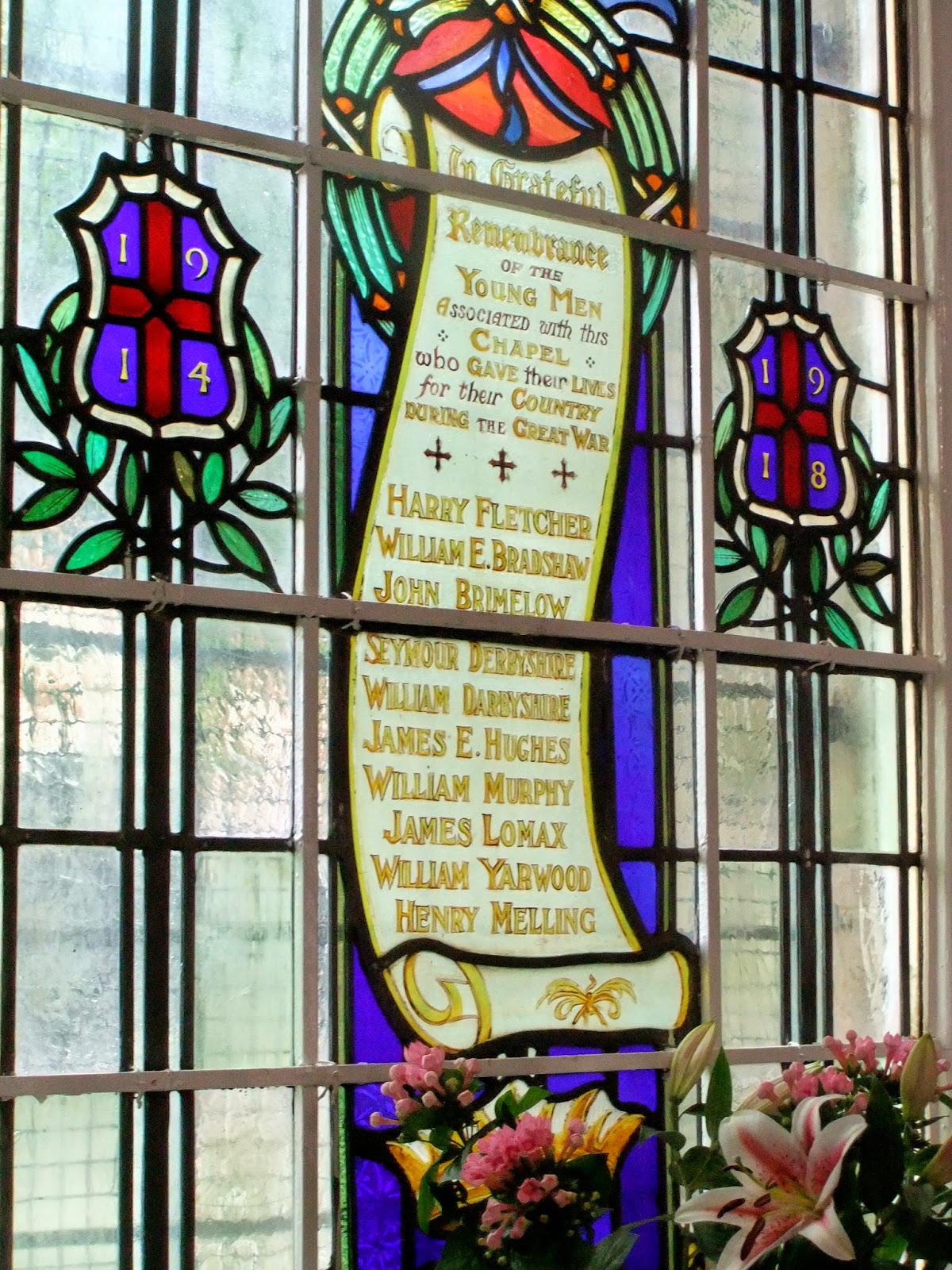
Chapel Remembrance Window - Copy

They were not just soldiers. They were bricklayers and collier workers and parcel clerks. They were Sunday School teachers and part of the congregation at this chapel, who sat in these pews. They were sons and brothers and new husbands. They were dear mates at the pub. They liked a good laugh.

Before, not long before, they were children, boys on the way to becoming men. They played in the fields around here, on the hills and in the woods, in Bryn and Billinge and Ashton. They may have played at being soldiers, but they were not soldiers. Not at first. Not until the call came. And then came the call. The nation asked them into service. Continue reading

Posted in Sermons, Sermons - Text | Tagged , , , , | Leave a comment

Your Monday Blessing: Photographs

Photographs

The faded colours of the old ones
Are buried in trunks for a time,
Until those trunks are opened,
And they, who no longer need the light,
Fill a room within us
With another’s captured brilliance.

Posted in Your Monday Blessing | Leave a comment

Your Monday Blessing: How Love Gets Made

How Love Gets Made

Our hearts beat time
As neurons race to build a bridge
To anything outside of itself.
A thousand strands hoist sparks to greet the wind.
A network of millions carries enough excitement
To be aware of the other person in the room.
Two generals, time and chance,
Lead an army of a hundred billion bowstrings,
Lashing out against the ramparts of the isolated self,
Where death’s power is ever under threat.

Posted in Devotional Poetry, Your Monday Blessing | Tagged , , | Leave a comment

Tanka: everything left

Love is everything
you left in the sink,
the washing up that awaits
the heart that’s ready
for warm suds and rolled-up sleeves.

Posted in Devotional Poetry | Leave a comment

The Eritrean

The Eritrean

Haftom Zarhum, an Eritrean,
asylum seeker, and human being,
was crawling on the floor, as bullets flew.
Haftum was following the rules laid down
for outsiders in a strangers’ country.
But all the wide white world knows a black man
is guilty. Security tapes caught him
on all fours, unarmed, and caught the soldier
who ran in there and shot the first bad guy
he saw. But now the trial. A Jewish mob
hurled a bus bench on Haftom’s head, kicked out
against the face of the prostrate other.
They killed Haftom Zarhum. And more besides
the Eritrean died there, blow by blow.

Posted in Uncategorized | Leave a comment

Your Monday Blessing: Special Offer

I don’t want to brag, but sometimes
I walk the little lane behind the recycling drums,
and, if the stars are out at night,
I purchase the entire universe in exchange
for whatever happens to be in my breast pocket.

Posted in Devotional Poetry, Your Monday Blessing | Leave a comment